
Men's Shirts Made in USA 2026: Big and Tall Guide
Table of Contents
- Why Men's Shirts Made in USA 2026 Are Worth the Investment
- Big and Tall Shirts Made in USA: The Fit Problem Nobody Solves
- How to Identify Authentic American-Made Clothing
- Fabric and Construction: What Separates Premium from Ordinary
- The RTG-ALW Classic Long Tee: A Closer Look at the Fit and Fabric
- What to Ignore When Shopping for American-Made Shirts
- Conclusion: Building a Wardrobe of Shirts That Actually Fit
- Frequently Asked Questions
Last Updated: October 2, 2026
Why Men's Shirts Made in USA 2026 Are Worth the Investment
The case for men's shirts made in USA 2026 starts with a simple problem: most big and tall shirts are just scaled-up versions of standard sizes, and they fit almost nobody. At RTG-ALW, we build shirts from scratch for larger frames, which is why this guide exists. The FTC's Made in USA labeling standard sets a strict bar for that claim, and most shirts that wave the flag do not clear it.
In practice, a shirt genuinely cut and sewn domestically passes through fewer hands, gets inspected more often, and is easier to trace when something goes wrong. That matters more for big and tall shoppers, because a bad fit costs a return, a wait, and another gamble.
Below: how to spot authentic domestic construction, what fabric and stitching signal quality, and how to get your size right the first time.
Big and Tall Shirts Made in USA: The Fit Problem Nobody Solves
Standard big and tall shirts fail predictably: they add width everywhere to gain length. The result fits your shoulders, balloons at the waist, and still rides up when you sit.
Sizing up to get length is a common mistake that costs you the chest and shoulders. Length and width are separate measurements, and a shirt built for a tall frame should add one without the other.
- Length: covers the belt line and stays tucked through movement
- Chest and shoulders: structured, not stretched
- Waist: relaxed without the tent effect
- Sleeves: fitted through the arm, not hanging loose
How to Identify Authentic American-Made Clothing
Authentic American-made clothing carries a label stating the country of origin and, when a brand claims domestic production, meets the FTC's "all or virtually all" standard, every significant part and process, including the fabric, happens domestically.
Reading the FTC Label: What 'Made in USA' Actually Means
A "Made in USA" claim means all or virtually all significant parts and processing are domestic (the FTC). The FTC standard applies to the fabric, not just the final cut and sew, so a shirt assembled here from imported cloth does not qualify for an unqualified claim.
Look for qualified wording instead: "Assembled in USA," "Sewn in USA," or "Made in USA of imported fabric." Those are legal, but they tell you the fabric came from somewhere else.
Red Flags That Signal Imported Fabric in a Domestic Shirt
Vague origin language is the clearest warning sign. If a label says "designed in" or "crafted for" without naming where the fabric was woven, assume the cloth was imported.
- No fiber content listed alongside the origin claim
- "Made in USA" with no mention of fabric origin anywhere on the listing
- Country of origin buried in a shipping note rather than the product label
- No traceability information available when you ask
Fabric and Construction: What Separates Premium from Ordinary
Premium construction shows up in three places: the fabric blend, the stitch density, and the interlining inside the collar and cuffs. A heavyweight cotton shirt with tight stitching holds its shape through repeated washing; a thin one loses structure after a season. But "premium" is marketing until you test fabric against the three failures that ruin a shirt: shrinkage, wrinkles, and heat retention.
The Three Performance Tests Nobody Runs
Most listings give fiber content and stop there. Here is what to measure instead.
Shrinkage. Cotton shrinks on first wash depending on how the fabric was finished.
Wrinkle resistance. This comes from weave tightness and fiber blend, not a chemical finish.
Breathability. How fast moisture moves through fabric is governed by fiber choice more than weight. Lyocell moves moisture faster than cotton and stays cooler in humidity.
Reading the Construction Signals
| Signal | What It Tells You | Why It Matters |
|---|---|---|
| Fiber content on label | Whether fabric is domestic or imported | Determines true origin claim |
| Stitch density at seams | Construction quality | Predicts how long it holds shape |
| Interlining in collar | Structure retention | Prevents collar roll and sag |
| Weave type | Shrinkage and wrinkle resistance | Affects fit after washing |
| Pre-shrinking | Residual shrinkage under ~3% | Keeps body length on tall frames |
| Blend ratio | Breathability vs. stretch trade-off | Governs all-day comfort |
Why This Matters More on a Tall Frame
A half-inch of shrinkage is invisible on a standard shirt. On a tall shirt, it is the difference between a hem that stays tucked and one that rides up every time you raise your arms, the difference between a shirt you keep and one you return.
The RTG-ALW Classic Long Tee: A Closer Look at the Fit and Fabric
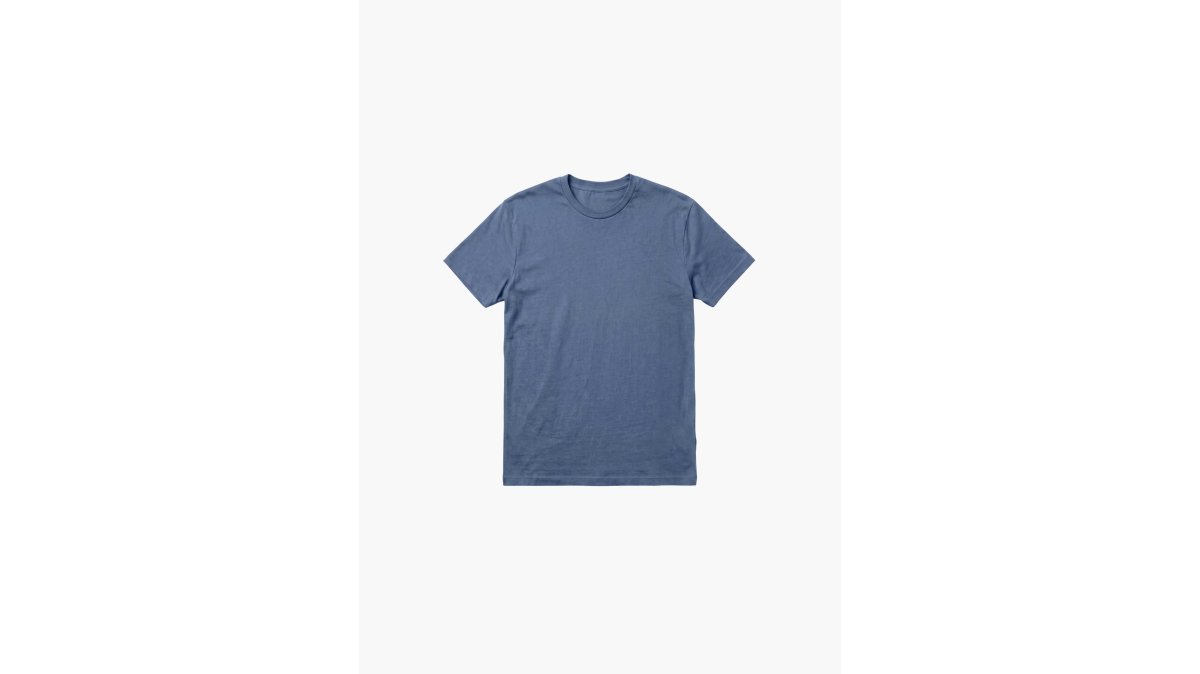
The RTG-ALW Classic Long Tee is a big and tall t-shirt built from scratch rather than resized from a standard pattern. It costs $68.95 and comes in Charcoal, Black, White, Scarlet, Blue, Navy, and Grey. Each one is cut and sewn in the USA.
The Classic Long Tee : Charcoal →

How to Measure Yourself Correctly
Use a flexible tape measure and keep it level, not pulled tight. Wear a fitted t-shirt, not a bulky one.

- Chest: measure around the fullest part, under the arms, keeping the tape parallel to the floor.
- Waist: measure at the natural waistline, roughly at the navel, not at the hip where pants sit.
- Torso length: measure from the top of the shoulder, next to the neck, straight down to the belt line.
- Sleeve: measure from the center back of the neck, across the shoulder, and down to the wrist bone.
Matching Your Numbers to a Size Chart
A shirt built for tall frames has a longer body and higher shoulder seam than a standard fit in the same labeled size, the same "Large" can differ by two or more inches of body length between brands.
| Body Type | Chest | Waist | Torso Length | What to Prioritize |
|---|---|---|---|---|
| Tall and lean | 38-42 in | 30-34 in | 21-23 in | Body length and sleeve length |
| Tall and broad | 44-48 in | 36-40 in | 21-23 in | Chest and shoulder structure |
| Big and tall | 48-54 in | 42-48 in | 20-22 in | Relaxed waist without tent effect |
| Extra tall | 40-46 in | 32-38 in | 23-25 in | Maximum body length |
These ranges are starting points. Find the row matching your chest and torso length, then check the waist column for a relaxed or structured cut.
The Between-Sizes Rule
If you fall between sizes, size to your chest and shoulders, not your waist. A tailor can take in a waist, but adding shoulder width means rebuilding the shirt. A slightly relaxed waist is a minor compromise; a shoulder seam that sits off your shoulder is not.
Check the Return Policy Before You Order
Even with accurate measurements, fit is personal. Before ordering, confirm the return window, whether returns are free, and whether the brand accepts washed or worn shirts.
- Measure chest, waist, and torso length
- Compare to the brand's own chart, not a generic one
- Size to chest and shoulders when between sizes
- Confirm the return window and whether it is free
What to Ignore When Shopping for American-Made Shirts
Ignore the flag graphic. A patriotic patch or logo says nothing about where the fabric came from or how the shirt was built. The label and the brand's willingness to answer questions are what count.
Ignore "premium" as a standalone claim. It is a marketing word with no standard behind it. Look for fiber content, fabric weight, and stitch details instead.
Ignore deep discounts on domestic shirts.
Conclusion: Building a Wardrobe of Shirts That Actually Fit
The hard part of buying men's shirts made in USA 2026 is not finding domestic options. It is finding one that fits a big and tall frame without compromise. Most brands solve length by adding width, and that trade never works.
RTG-ALW builds the Classic Long Tee for exactly this problem: a longer body that stays tucked, a structured chest with a relaxed waist, and a lyocell, cotton, and spandex blend that breathes all day. Every shirt is cut and sewn in the USA and sized from 6'2" to 6'7".

Get started with RTG-ALW and stop settling for shirts that ride up, balloon out, or fall apart after a few washes.
Frequently Asked Questions
How can I verify if a shirt is truly made in the USA?
Check the FTC label for a 'Made in USA' claim. For an unqualified claim, all significant parts and processing must be of domestic origin. Look for specifics like 'Cut and sewn in the USA' or 'Made in USA from imported fabric.' If the label only says 'Designed in USA' or 'Assembled in USA,' that's a red flag. You can also ask the brand directly about their supply chain traceability.
What are the benefits of buying big and tall shirts made in USA?
Domestic manufacturing often means tighter quality control and better working conditions. For big and tall men, American-made shirts frequently offer patterns designed for specific body types, not just scaled up from standard sizes. This means the shirt holds its shape and resists shrinkage after multiple washes.
Does 'Made in USA' mean 100% of the materials are sourced domestically?
No. The FTC allows a qualified 'Made in USA' claim if the product is processed or assembled here but uses imported materials, as long as the label clearly states the imported content, like 'Made in USA from imported fabric.' An unqualified claim requires that all or virtually all significant parts and processing be domestic.
I'm 6'4" and 280 pounds. How do I know an American-made shirt will fit my build?
Look for brands that publish detailed sizing charts with measurements for chest, waist, and length, not just S/M/L. A shirt designed specifically for big and tall frames will have a longer body length that covers the belt and stays tucked, plus a structured chest with a relaxed waist to avoid the tent effect. Check customer reviews from men with similar builds to see how the shirt fits in practice.
What materials are commonly used in high-quality domestic shirts?
Blends like lyocell, cotton, and spandex are popular for breathability and stretch. Look for details on fabric weight, thread count, and weave type. Higher stitch density per inch and quality interlining in the collars and cuffs also indicate better construction and longer wear.