
Best Fitting Shirts for Broad Shoulders: 7 Picks That Work
Table of Contents
- Why Most Shirts Fail Men With Broad Shoulders
- How a Shirt Should Fit Across the Shoulders and Chest
- The Best T-Shirts for Men With Broad Shoulders
- Shirts for Broad Shoulders and a Narrow Waist
- Athletic Fit Shirts for Men: What the Label Actually Means
- Stretchy Fitted Dress Shirts for Men Who Move All Day
- A Measurement-Based Fit Guide for Broad Shoulders
- Conclusion
- Frequently Asked Questions
Last Updated: October 18, 2026
Why Most Shirts Fail Men With Broad Shoulders
Most shirts are drafted from one block: a narrow shoulder line, a straight torso, and a waist that assumes your chest and hips are roughly the same width.
Size up until the shoulders clear and the waist tents at the midsection.
Neither failure is about your body. It's about a block never drawn for your proportions.
The fix isn't one magic size. It's knowing which measurements matter and which fit labels actually mean something.
How a Shirt Should Fit Across the Shoulders and Chest
A well-fitting shirt puts its shoulder seam at the edge of your shoulder bone, not hanging past it and not pinching inward.
The chest should skim your torso without pulling. Horizontal tension lines from armpit toward sternum mean the chest is too tight.
Then check the waist. A shirt for broad shoulders and a narrow waist should taper inward below the chest rather than falling straight down.
Quick test in the fitting room:
- Raise both arms overhead. The hem should not climb above your belt.
- Cross your arms. The shoulder blades should not feel like they're splitting a seam.
- Sit down. If the shirt rides up and stays up, the length is wrong.
The Best T-Shirts for Men With Broad Shoulders
A T-shirt is the hardest piece to get right because knit fabric shows every pull and bag. The best T-shirts for men with broad shoulders solve both: enough length to stay put, enough shape to avoid the tent effect.
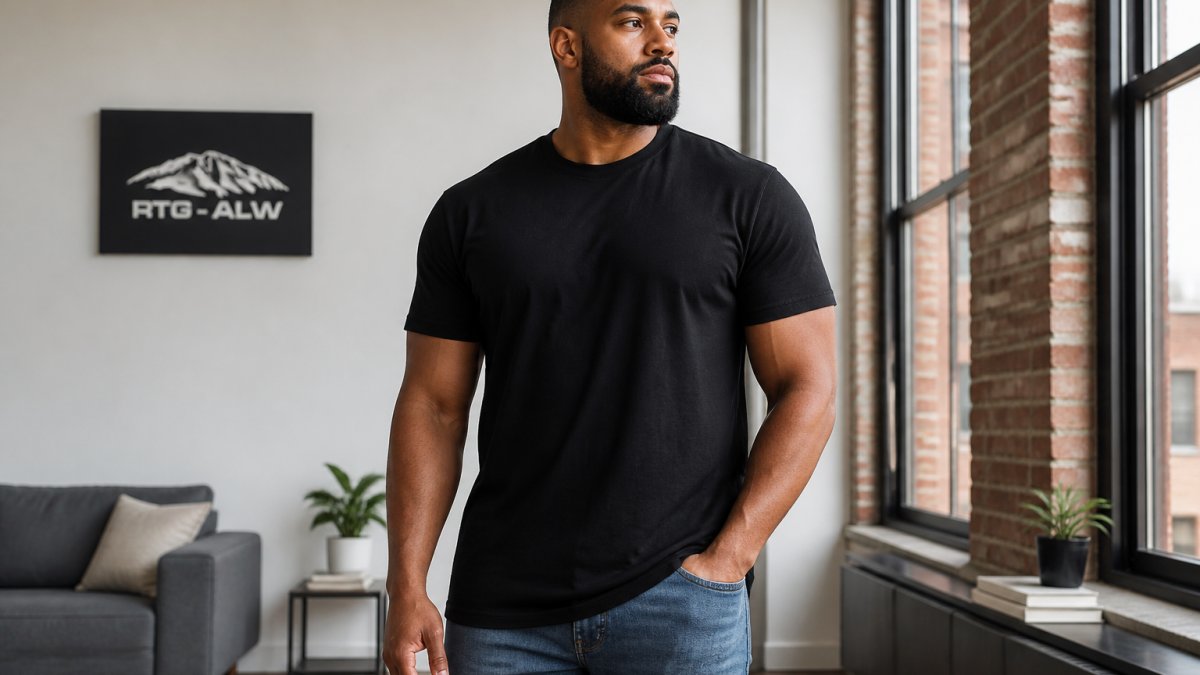
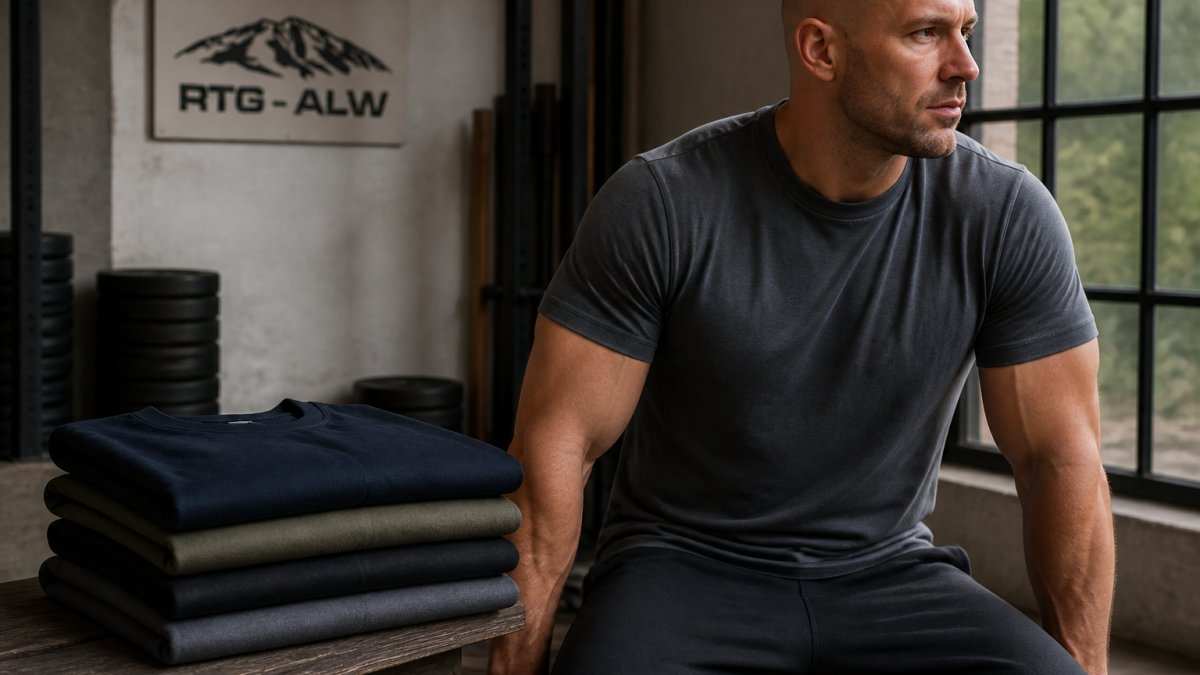
That's the design brief behind our Classic Long Tee: a lyocell, cotton, and spandex blend with a structured chest and relaxed waist so it follows your shape instead of hanging off it.

The Classic Long Tee: Black, White, and Charcoal
The three core colorways are the workhorses: black reads clean under a jacket, white handles summer heat, and charcoal hides desk-day creases. All three are $68.95 with the same belt-covering length.
Big and Tall Long Tees in Blue, Navy, and Grey
Stellar Blue, Navy, and Light Gray cover the same ground at the same $68.95, with the same structured chest and relaxed waist.
The Long Sleeve Tees for Cooler Days
The long sleeve tees run $79.00 in Black, Navy Blue, Stellar Blue, and Light Heather Gray, sizes Large through XXXL. The cotton and lyocell fabric keeps the extended-length design big and tall men need. They're machine washable and eligible for bundle and mix-and-match options with other qualifying tees.
Shirts for Broad Shoulders and a Narrow Waist
Shirts for broad shoulders and a narrow waist need one thing above all: a real taper. Without it you get the triangle problem, where the shirt fits your shoulders and billows over your stomach.
The taper has to come from the cut, not from tailoring after the fact.
Fabric matters too. Stiff cotton poplin resists tapering and fights your body, while a blend with some spandex lets the waist follow you without bunching.
Athletic Fit Shirts for Men: What the Label Actually Means
"Athletic fit" is the most abused term in menswear.
Athletic fit shirts for men should be wider at the chest and shoulders than a slim fit, then narrow sharply at the waist.
| Fit Label | Chest | Waist | Best For |
|---|---|---|---|
| Classic | Straight | Straight | Average builds |
| Slim | Trim | Trim | Lean frames |
| Extra-slim | Very trim | Very trim | Very lean frames |
| Athletic | Broad | Tapered | Broad shoulders, narrower waist |
| Big and tall | Broad | Relaxed | Larger frames needing length |
The practical advice: ignore the label and check the size chart's chest-to-waist ratio. If the difference is under 2 inches, it's not an athletic cut no matter what the tag says.
How to Read a Size Chart Like a Patternmaker
Most size charts list a chest and waist measurement per size. Those two numbers are the whole story:
The Classic Long Tee : Black →
- Find the chest-to-waist drop. Subtract the waist number from the chest number for your size. A drop of 6 inches or more signals a genuine athletic or tapered block. A drop of 2 to 4 inches is a classic or straight cut. Under 2 inches is a slim cut that will likely tent at the waist on a broad-shouldered frame.
- Check the shoulder-to-shoulder measurement. This decides whether the shirt clears your frame at all. Compare it to your own shoulder width measured across the back from bone edge to bone edge. A shirt should match within about half an inch.
- Compare flat measurements to body measurements, not the other way around. A shirt's armpit-to-armpit measurement doubled should land close to your chest circumference plus 2 to 3 inches of ease for a fitted shirt, or 4 to 5 inches for a relaxed one. If it's smaller than your chest circumference, the shirt will pull.
- Look for a stated taper or a waist panel. Some brands publish a "taper" or "waist" measurement taken about 6 inches below the armpit. If that number is close to the chest number, the shirt is straight through the torso regardless of the fit name.
Why the Same Label Fits Differently Across Brands
Fit labels are not standardized. One brand's athletic fit can be another's slim fit, and a third brand's "tailored" cut may have more taper than either.
That's why the chest-to-waist drop matters more than the name on the tag. Two shirts both labeled athletic can have drops of 3 and 7 inches, and only one works on a broad-shouldered, narrower-waisted frame.
When No Off-the-Rack Athletic Fit Works
Some shoulder-to-waist ratios fall outside what mass-market grading covers. If your chest-to-waist drop is 8 inches or more, or your shoulder width puts you between sizes in every brand, an off-the-rack athletic fit may never land cleanly. The realistic options are a made-to-measure shirt or one cut from a block designed for bigger frames rather than graded up from a standard one.
Stretchy Fitted Dress Shirts for Men Who Move All Day
Stretchy fitted dress shirts for men solve a decades-old problem: a crisp dress shirt that looks sharp standing still but locks up the moment you reach for something.
The Construction Details That Decide Mobility
Stretch gets the attention, but four construction details decide whether a dress shirt actually moves with a broad-shouldered frame:
- Shoulder seam placement. A seam at the edge of the shoulder bone lets the sleeve hang cleanly. A seam inside the bone pinches the deltoid and restricts reach; a seam past the bone droops and bunches. On a broad-shouldered frame, check this first.
- Armhole height and shape. A high, close armhole follows the shoulder joint and moves with the arm. A low, deep armhole drags fabric up out of the waist when you reach overhead. For broad shoulders, a moderately high armhole with a little extra depth at the back is the usual compromise.
- Fabric weight. Lightweight poplin and broadcloth (roughly 3 to 4 ounces per square yard) breathe well and drape close to the body, which suits a tapered cut. Mid-weight twill and oxford (roughly 5 to 6 ounces) hold their shape and hide wrinkles better but resist tapering.
Stretch Percentage, Recovery, and Durability Trade-Offs
Stretch content is listed as a percentage of elastane or spandex, and the number carries real trade-offs:
- Around 1 to 2 percent elastane gives a subtle give across the shoulder blades and through the elbows without changing how the fabric drapes. Recovery is good, and the shirt keeps its shape through repeated washing.
- Around 3 to 5 percent gives noticeable stretch and is common in performance dress shirts. It moves well, but the fabric can feel slicker and may pill at the collar and cuffs over time.
- Above 5 percent behaves more like a knit than a woven. It stretches easily but recovers less reliably, and the shirt may lose its crisp look after a few months.
Recovery matters most for a dress shirt. A fabric that stretches but doesn't snap back will bag at the elbows by mid-afternoon. A blend in the 2 to 4 percent elastane range hits the best balance of movement, shape retention, and durability for a shirt worn five days a week.
Matching Fabric to the Job
Different workdays call for different fabric trade-offs:
- Office and client-facing days: a mid-weight cotton with 2 to 3 percent elastane in a tapered cut. It holds a press, hides minor wrinkles, and moves enough for desk work.
- Travel and long commutes: a lighter weight blend with 3 to 4 percent elastane and a wrinkle-resistant finish. It packs smaller, recovers from a bag, and the stretch handles sitting for hours.
- Active or field days: a performance blend with 4 to 5 percent elastane and a breathable weave. Prioritize moisture movement and armhole shape over crispness.
A Measurement-Based Fit Guide for Broad Shoulders
Guessing your size from a height and weight chart is how most men end up returning shirts.
Step 1: Shoulder width. Measure across your back from the edge of one shoulder bone to the other.
Step 3: Waist taper. Measure your natural waist, then subtract it from your chest measurement.
Then compare those numbers to the brand's flat measurements, not your body measurements.
Conclusion
The right shirt for broad shoulders isn't a size up or a size down.
That's the whole reason RTG-ALW exists. Our Classic Long Tee is built for big and tall frames with belt-covering length, a structured chest, and a relaxed waist, in a breathable lyocell, cotton, and spandex blend cut and sewn in the USA.

Stop resizing standard shirts and hoping. Shop the Classic Long Tee and get a fit designed for your build from the first stitch.
Frequently Asked Questions
What are the best T-shirts for men with broad shoulders?
Look for a shirt cut from scratch for a wider frame rather than a standard tee sized up. The shoulder seam should land at the edge of your shoulder, the chest should sit flat without pulling, and the waist should taper instead of hanging like a tent. RTG-ALW's Classic Long Tee is built this way, with a structured chest, relaxed waist, and belt-covering length in sizes L through 3XL at $68.95.
How should a shirt fit across the shoulders and chest?
The shoulder seam should end where your shoulder slopes down, not past it. If the seam drops onto your upper arm, the shirt is too big. Across the chest, the fabric should lie flat with no horizontal pull lines at the buttons or armpits. You should be able to pinch about an inch of fabric at the chest. Anything tighter restricts arm movement; anything looser creates the boxy shape broad-shouldered men usually want to avoid.
What shirts work best for broad shoulders and a narrow waist?
You need a shirt with a taper through the torso, sometimes called a waist taper or torso taper. Athletic and tailored fits cut the waist narrower than the chest, which stops the fabric from billowing. Stretch helps too: a lyocell, cotton, and spandex blend moves with your chest and arms while the waist stays close. Avoid straight-cut or classic fits, which assume the chest and waist are nearly the same width.
Are athletic fit shirts for men worth it if I am tall as well as broad?
Yes, but check the length first. Athletic fits solve the chest-to-waist ratio, yet many are cut short, so the shirt untucks the moment you reach overhead. Look for an extended-length option that covers the belt and stays put. RTG-ALW tees list fit examples at 6'2" and 6'7", which helps taller men judge whether the length will hold through a full workday.
Can I wear stretchy fitted dress shirts for men if I have a big chest?
Stretch fabric is one of the better options for a broad chest because it gives at the shoulders and arms without pulling at the buttons. Choose a dress shirt with a defined waist taper and a touch of spandex or elastane in the blend, then check the armhole height. A higher armhole keeps the sleeve from twisting when you lift your arms. If the chest fits but the waist is loose, a tailor can take in the sides for a modest fee.